 DravyaOS
A busy counter feels like a healthy shop. It isn't always. The same week that takes ₹3 lakh across the counter can also have a lakh of stock quietly going out of date, three regulars who stopped coming, a supplier whose rate crept up twice, and a Schedule H bill with no doctor's name on it. None of those shows up in the day's takings.
Most owners know this and check anyway, a report at a time, when they remember. The problem isn't effort. It's that "how is my shop doing?" has no single place to be answered. So here is what a proper answer looks like: five areas, one number, and a short list of what to fix first.
Why a single number helps
A score isn't meant to flatter or to scold. It exists so that you can compare the shop with itself. Is it better than last month? Did the thing I fixed on Tuesday actually move anything? A figure you can glance at beats a dozen reports you have to open, choose a date range for, and read to the end.
The number only earns its place if it comes with its reasons. A bare "62 out of 100" is useless. "62, because dues over 30 days are high and 14 lots are close to expiry" tells you what to do before lunch.
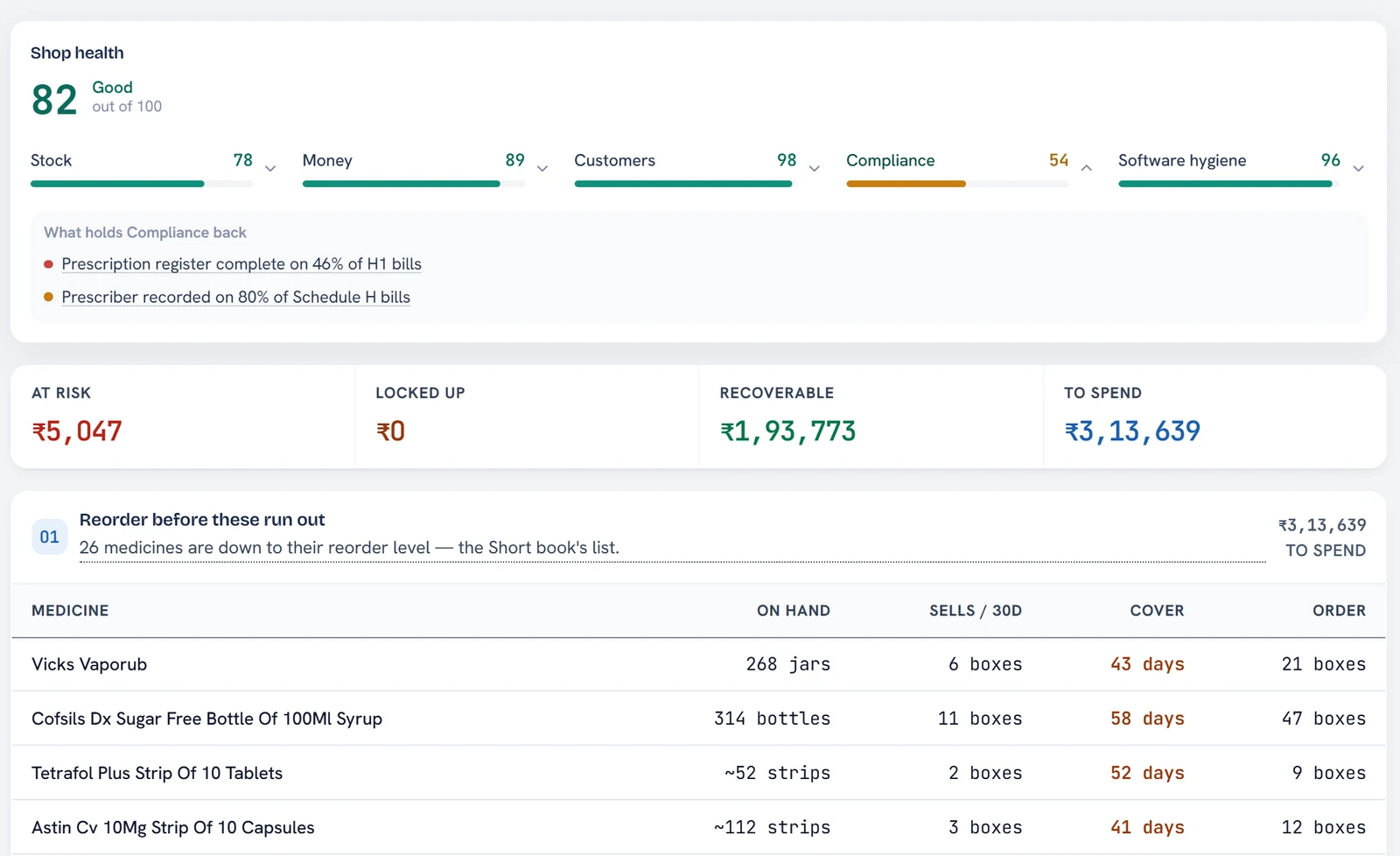
The five areas
1. Stock
The heaviest area, because it is where the money sits. It looks at how many medicines are short and how often they appear on bills, since a stock-out on a line that sells all day matters far more than one on a line that sells twice a year. It also looks at dead stock, lots close to expiry, and lots already past it. Expired stock is the loudest loss; the quiet one is stock that will expire before it sells, which is why that check compares expiry against the actual selling pace.
2. Money
Customer dues past 30 days and supplier dues past 60, set against a month of sales or purchases so the size of the shop doesn't distort it. Then margin, bills sold at a loss, purchase rates that went up, sales lost for want of stock, and how much discount is going out. Each of these is one that an owner would spot on a good day and miss on a bad one.
3. Customers
Bills a day and the takings on a typical day, set against the 90 days before. Plus regulars who are late for a refill. A pharmacy lives on repeat customers, and a quiet drop in them shows here weeks before it shows in the monthly total. If you haven't yet, read how a refill list is worked out from your own bills.
4. Compliance
Is the Schedule H1 register complete? Do Schedule H sales carry a prescriber? Were any sales made from expired lots? Are the drug licence and GSTIN filled in? These are the things an inspector asks for, and it is far better to find the gap yourself on a Tuesday. See also keeping the H1 register properly.
5. Housekeeping
The least glamorous area and the one most often skipped: medicines with no pack size, lots with no expiry, customers with no phone number, and whether this computer has synced, backed up and updated recently. Missing details don't hurt today. They hurt the day a report depends on them.
What makes a score fair
Here is where a lot of health checks go wrong. If a score counts rupees or piece-counts, a big shop will always look bigger and a small shop will always look worse, even with better habits. A fair check measures ratios, shares and days: what share of lines are short, how many days overdue, how far discount sits above its usual level. Then a shop with ten bills a day and good habits scores the same as a shop with a hundred and the same habits.
It should also be honest about what it doesn't know. If a measure doesn't have enough data, it is left out, and the rest of its area carries the weight, rather than guessing. And a shop only a few weeks old shouldn't get a score at all, because the first month of bills moving into a new system looks like growth that isn't there.
Then the list, ranked by money
Under the score sits the part that makes it useful: the individual findings, ranked by the rupees at stake. What to reorder, what is dead stock, which regulars are late, which batches will expire before they sell, which purchase rates rose receipt over receipt, and which Schedule H bills have no prescriber. Each has the rupee figure beside it, the rows it came from, and a door to the screen where you fix it. The four money totals (at risk, locked up, recoverable, to spend) are kept apart and never added together, because a sum of them would mean nothing.
It works with no internet
Every one of these is arithmetic over data already on your computer: a division, a date comparison, one invoice line against the previous. So the check should run offline, instantly, and cost nothing per use. DravyaOS calls it Shop Health. It opens already worked out, it reads from the same Short book as the reorder screen so the two never disagree, and someone without access to cost prices sees what is dragging a margin down but not the figure.
Free for 3 days. Offline, and built for the counter.
Download DravyaOS for WindowsRelated reading: spotting stock and dues problems at a glance, batch and expiry management, and managing customer credit.