 DravyaOS
Every chemist knows the words — MRP, PTR, PTS, margin, scheme. Fewer can say, on a given box, exactly how much they actually make after GST and the free goods are accounted for. That gap is where profit quietly leaks. Here's the whole chain, in plain terms, with the arithmetic worked out.
Figures below are illustrative to show the method. Your real rates depend on the product, distributor, and current GST — always price from your own purchase invoice.
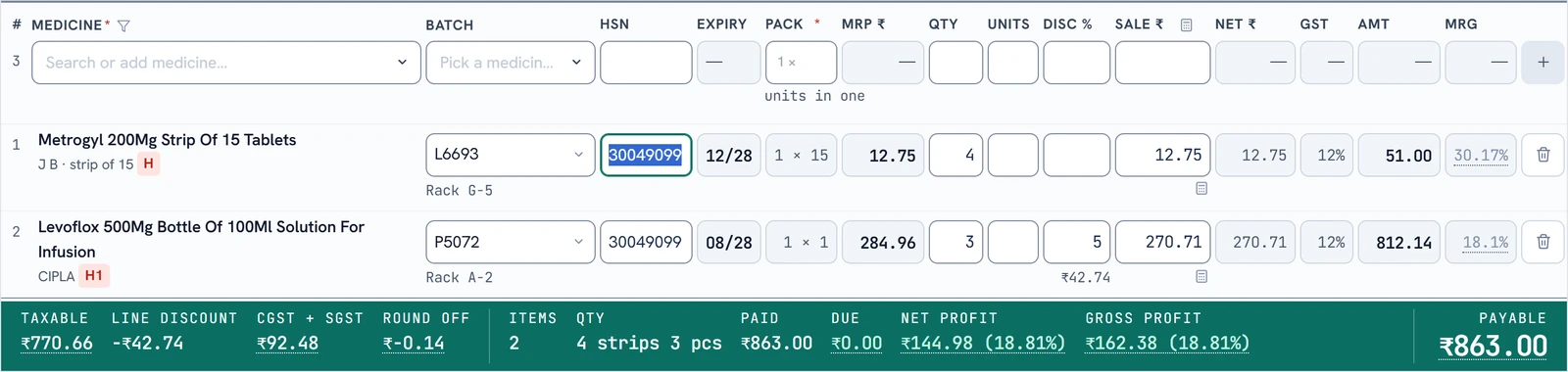
The three prices on every box
- MRP (Maximum Retail Price) — the printed ceiling. You may sell at or below it, never above. This is what the customer sees.
- PTR (Price to Retailer) — what you, the pharmacy, pay the distributor per pack.
- PTS (Price to Stockist) — what the distributor pays the stockist/company. It's usually below PTR; the difference is the distributor's margin.
As a retailer, your buying price is the PTR. Your selling price is at most the MRP. The space between the two is your gross margin — before GST and before any scheme is folded in.
Where GST sits in the chain
A common mistake is comparing a GST-inclusive MRP against a GST-exclusive PTR and celebrating a margin that isn't there. MRP is inclusive of GST. To compare like with like, strip the tax out of both, or add it to both — just be consistent. Your true trading margin is on the taxable (pre-GST) values, because the GST you collect isn't yours; it passes through to the government.
A worked margin, step by step
Take a strip with MRP ₹100, GST 5%, PTR ₹78 (this PTR is typically GST-inclusive on your purchase invoice — check yours). Work in pre-GST terms:
- Taxable MRP: 100 ÷ 1.05 = ₹95.24
- Taxable purchase (PTR): 78 ÷ 1.05 = ₹74.29
- Gross margin: 95.24 − 74.29 = ₹20.95 per strip
- Margin on selling price: 20.95 ÷ 95.24 = ~22%
Sell below MRP (a customer discount) and that margin shrinks rupee-for-rupee. A ₹5 discount on this strip cuts your ₹20.95 by nearly a quarter — which is why casual "rounding down" adds up fast across a day.
Schemes and free goods change the real cost
A 10+1 scheme means you receive 11 units but pay for 10. Your effective purchase cost per unit drops: pay for 10 at ₹74.29 taxable = ₹742.90 spread over 11 units = ₹67.54 each. That lifts the per-unit margin from ~22% to roughly 29% — but only if you actually record the free goods. Book the free unit as zero-cost stock and your margin reports lie to you in both directions: cost looks too high, and the "free" unit looks like pure profit when it isn't.
The mis-keyed price: the silent margin killer
The fastest way to destroy a day's margin isn't a bad scheme — it's a typo. Enter a sale rate of ₹8.90 instead of ₹89.00, or a purchase cost with a slipped decimal, and every bill on that item runs at a loss until someone notices. On a busy counter, nobody notices for weeks.
The fix is a guardrail: software that knows the expected range for an item and flags a price that falls outside it before the line is saved — a cost above MRP, a sale rate a decimal place off, a margin that's gone negative. It's a two-second confirm that saves a month of quiet losses.
Different customers, different prices
A retail walk-in, a regular credit customer, and an institutional buyer rarely pay the same. If your software can hold a customer- or batch-specific rate, the right price appears automatically when you pick the buyer — no mental arithmetic, no under-charging your best margin away, no over-charging a loyal khata customer by mistake.
How DravyaOS keeps margins honest
DravyaOS stores sale and purchase rates per item and per batch, folds scheme and free-goods discounts into a true net rate, and shows margin as you bill. It catches a mis-keyed price before it's saved, and it reflects the customer you're billing — so the number on the line is the number you actually meant. Offline and keyboard-first.
See your real margin on every line — offline, no invoice cap.
Download DravyaOS for WindowsNext: keep write-offs from eating those margins with batch & expiry tracking, or make sure the tax side is clean with our GST-compliant bill guide.